Anthropogenesis - The Evolution of Human Consciousness
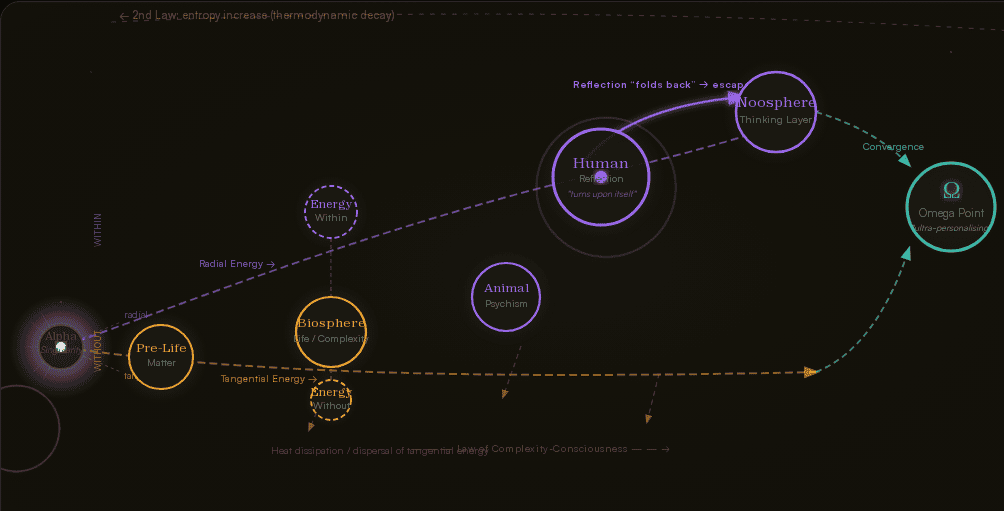
Pierre Teilhard de Chardin SJ who died in 1955, was a Jesuit theologian and leading paleontologist who strived to unite science and theology, particularly evolutionary theory. I first read his books back in the 1970s when living in Oxford. What chimed with me was his ideas that ever since the first spark of creation, the Alpha Point (the Big Bang), life has continued to evolve through what he called a process of complexification. From the creation of the basic building blocks of matter - to stars, planets and simple lifeforms to ever more complex entities, culminating on Earth, at least, as humans. His idea was that the universe would ultimately become reflective and perceive and be in communion with its creator. An evolution with purpose and not based on random evolutionary improvements, but somehow pulled forward by the Omega Point, powered by radial energy, the most powerful form being love.
Tangential energy dissipates with use, while radial energy continually increases with use, as Complexity and Consciousness continue to increase (1).
I cannot do justice to his theories here, but the evolutionary process will continue until we reach the Omega Point where the universe's energy, he termed tangential energy, is spent - in line with the 2nd law of thermodynamics. Meanwhile a second type of spiritual energy or energy of consciousness, he termed radial energy, will continue to evolve and ultimately manifest in its highest level of unification with God in the spiritual body of Christ.
He called this process of evolution: Anthropogenesis.
Condemnation by the Vatican but partial rehabilitation since his death.
His visionary spiritual theories didn't go down well with the Vatican, who exiled him to China, where he continued his work as a paleontologiest and was on the team that discovered Peking Man, an early hominid that lived in northern China around 770,000 to 230,000 years ago. He was barred from preaching despite being a Jesuit priest, and his two famous books were published after his death. Teilhard's evolutionary theories received an official Vatican warning (a Monitum) in 1962.
However, there has been some rehabilitation, with Pope Francis publishing his encyclical Laudato Si2 in 2015. In paragraph 84, Pope Francis wrote:
Since then, further attempts to rehabilitate Teilhard's reputation continue. In 2017 the Pontifical Council for Culture requested the rescinding of the 1962 Monitum. Now we have a new pope, Leo XIV, it is probably a matter of time before the Monitum is lifted. The Church broadly accepts the idea of evolution, but not the simplistic view that it is purely a material phenomenon driven without purpose and by the 'laws' of chance.
Footnotes:
1. Savary, Louis M.. Teilhard de Chardin's The Phenomenon of Man Explained (p. 99). Paulist Press. Kindle Edition.
2. Laudato Si quote by Pope Francis