Most of us are aware that the climate is in trouble. A few are still in denial. However, in their article, Fourth Person: The Knowing of the Field, Otto Scharmer (MIT) and Eva Pomeroy (The Presencing Institute), stated that the biggest problem facing us is not climate change, war, inequality, or the ‘proliferation of AI’ but a feeling at the individual level of complete powerlessness to do anything about it.
As I was to discover in my research from tiny beginnings, through great imagination and collaboration, global movements can be born - a community at a time. The Transition Network, is one such movement. Rob Hopkins and a few like-minded friends wondered what they might do to create a community-led and bottom-up response to the climate emergency. They embarked on a local community project named Transition Town Totnes, which sparked such international interest that in March 2007, Transition Network was officially launched.
It's now spread across the globe bringing local communities together to embark on what the cynics might say are impossible journeys.
At the heart of its success is imagination, hope and community-led agency.
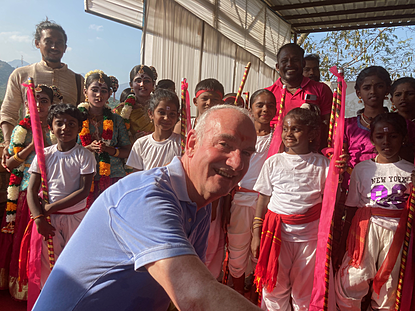
Look at the hope and joy on the faces of these children at Zoho's village school in Tenkasi, Southern India.
Toward the end of our analysts tour in February 2023, we flew to Zoho’s rural school and farm in Tenkasi, Kalaivani Kalvi Mayam. The school, led by Akshaya Sivaraman and nine teachers, provides free education (and meals) for around 100 children.
Akshaya Sivaraman explained the three principles governing their approach to teaching:
My fundamental belief is that to solve mega-challenges such as climate change, justice and poverty, all life and the supporting planet must be considered sacred. As my research progresses it only reinforces this view. There must be a shift from dualism to unity, from anatomic thinking to connected living bio-systems and ecosystems thinking. Somehow we must raise our consciousness levels significantly, to recognise how we are all connected, and that real wealth comes from the depth of our inter-generational relationships. A bountiful world as God intended it to be at the outset of creation. And God saw everything that He had made, and behold, it was very good.
Or, as Pope Francis wrote in the encyclical: Laudato Si (2015): ''We're building hell on Earth - whereas our job is to prepare the World for God's earthly Kingdom.'' As he points out, markets are deified, sacrificing life and all living systems, with the poorest suffering the most. Fundamentally we have the wrong mindset, we lack the right level of consciousness. We need a mindset that recognises every life-form and the supporting ecosystem services offered by our planet, as sacred. Not as resources to be extracted for self-centred profit.