
A brief Explanation of Planetary Boundaries, by Professor Johan Rockström
A framework that is intuitive to understand and should be part of basic education in schools - no PhD required!
When I started my research (2023), I confess to being fairly ignorant of our planetary context. Climate change, as a term, has firmly entered the consciousness of most of us, yet beyond the idea that everywhere will get hotter unless we can reverse the damage of this Anthropocene era, we have a limited understanding of its dynamics, nor, seemingly, much personal agency to do anything about it.
Luckily, early on, I stumbled across the Stockholm Resilience Centre and the work of Professor Johan Rockström and his colleagues, who provided a succinct context for our planetary situation with the concept of planetary boundaries, which must not be crossed if we are to avoid triggering a succession of connected feedback loops with potential catastrophic consequences. (Rockström is also a scientific director of the Potsdam Institute for Climate Impact Research (PIK), a leading climate think tank funded by the German government.) Rockström is that rare scientist able to communicate the complexity of our multi-faceted climate crisis in easy-to-understand ways.
2025 - Seven out of Nine Planetary Boundaries Exceeded
Since 2009, the number of crossed boundaries has increased from three out of seven assessed to seven out of nine, meaning that without urgent correction, human-made causes will lead to the destruction of Earth’s protective ecosystem services, responsible for keeping us alive. Overreach in one boundary also affects others, potentially accelerating the decline to the point where any remedial action may come too late. Reducing the carbon footprint to Net Zero by 2050 may therefore be insufficient.
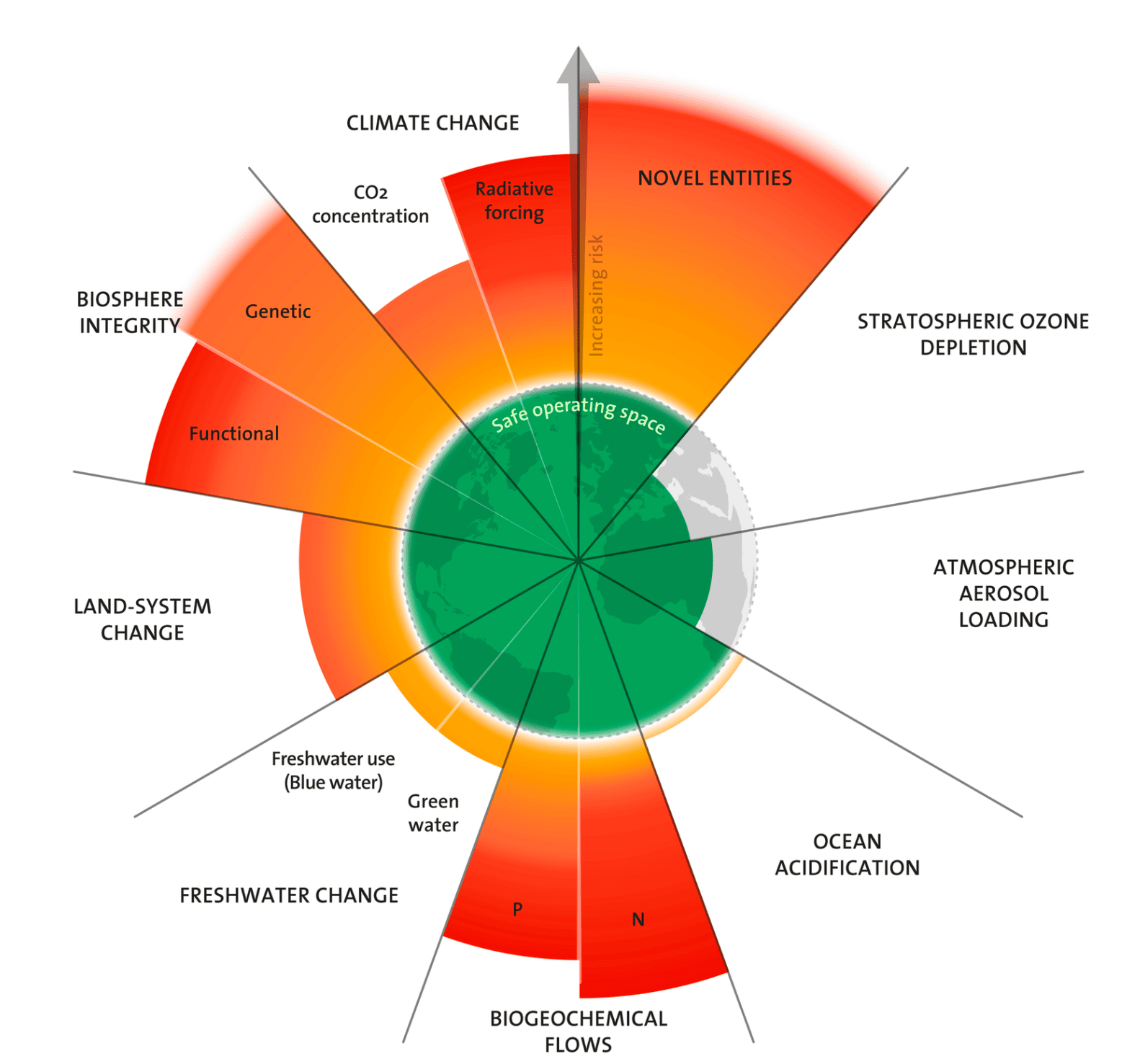
As you can see from the diagram, it is not simply a temperature rise that imperils all life on our planet, but a host of other symptoms that have been traced to human activities, hence labelled the Anthropocene, (from the Greek ‘anthropo’, human, and ‘cene’ from the Greek, “kainós,” meaning new)—an age where, for good or bad, human activities impact nature. The Anthropocene has unequivocally replaced the ‘safe operating space’ of the Holocene era, which has enabled humans to flourish over the last ten thousand years.
So what are these boundaries, and why are they vital for life?
The planetary boundaries framework provides a good introduction to a broader understanding of the climate crisis and its impacts. This basic awareness should be part of every school curriculum, as it will be the current crop of students who may have to carry the lion’s share of the remedial burden.
1. Climate Change - consisting of the level of CO₂ emissions caused mainly by industrial output, and radiative forcing, a measure of the difference between energy released into the atmosphere vs incoming energy from the sun. The safe upper limit for CO₂ is 350 ppm, yet we have already reached approximately 425 ppm.
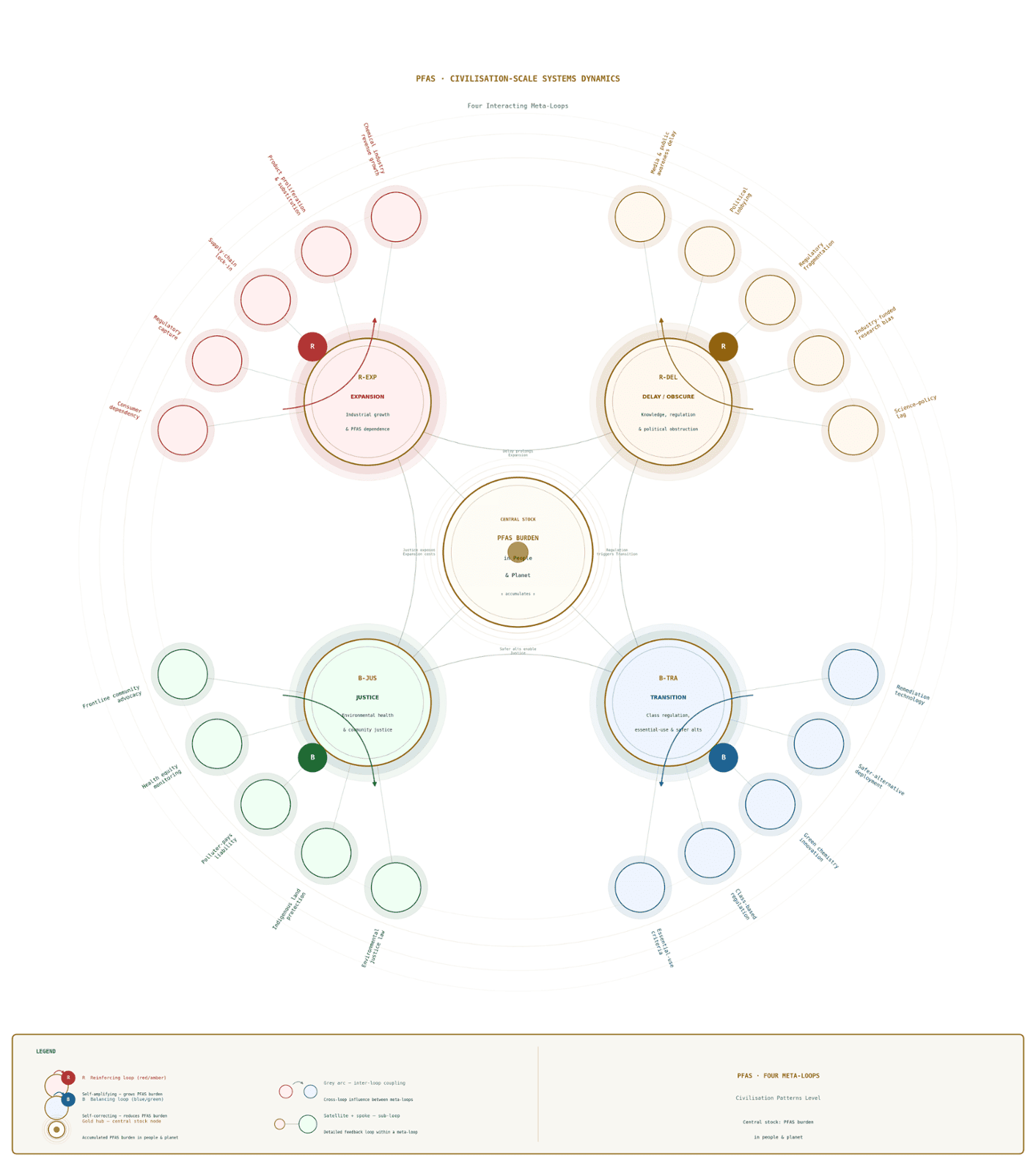
2. Introduction of Novel Entities - industrial/chemical pollutants are another boundary crossed. Some chemicals, PFAS (per‑ and polyfluoroalkyl substances), are a class of some 10,000 fluorinated compounds, more expressively called “forever chemicals because carbon-fluorine bonds don’t break down in nature, and have now been identified in human and wildlife blood, and continue to accumulate over time. They are used across a wide spectrum of products, including non-stick cookware, cosmetics, food wrappers, and various industrial operations. The growth in PFAs and their harms has gone largely unnoticed by the public. That is beginning to change; now the spectre of ‘forever chemicals’ is being brought to the public’s attention - see BBC Panorama: The Truth about Forever Chemicals1. The proliferation of PFAs is driven by two connected feedback loops, outlined in Figure 2: top left - industrial growth, and top right - weak regulation, as the chemical sector downplays the properties and potential harms of PFAs. The bottom two feedback loops have the potential to put the brakes on proliferation through the justice system (bottom left) and through forthcoming regulations (bottom right). Each has driving pressures illustrated by the attached satellite forces. There are around 10,000 + variants, and to date, a few have been banned, but not the entire poisonous class.
Unintended consequences…….again!
A 2024 proof‑of‑concept study measured 18 PFAS in human cerebrospinal fluid and found higher PFAS (especially PFOS) levels in individuals with both Alzheimer’s biomarkers and cognitive impairment compared with those without, providing first evidence of a link between PFAS accumulation in the CNS and AD markers. Expect to see more evidence like this. If there are historical records of dementia pre-PFAS, it would be interesting to see a comparison.
3. Stratospheric Ozone Depletion - This is a rare bright spot, showing that when intergovernmental agreement is reached, we have the agency to recover from a crisis. The Montreal Protocol, signed on September 16th, 1987, is an international agreement by 198 UN member governments to phase out chlorofluorocarbons (CFCs), which attack the protective ozone layer. The Antarctic ‘hole’ is now the smallest it has been since recovery began. At this rate, it should be closed by 2050.
4. Increase in Atmospheric Loading - Soot and pollutants, which threaten to destabilise large rainfall systems. Currently within safe boundaries but requires continuous monitoring, especially as Australia, China (by far the most), India, Russia, and South Africa are opening new coal mines due to demand for electricity and steel production.
5. Ocean Acidification - In 2025, this became the seventh boundary to be transgressed. As Rockström said: “We are witnessing widespread decline in the health of our planet. But this is not an inevitable outcome. The drop in aerosol pollution and healing of the ozone layer show that it is possible to turn the direction of global development. Even if the diagnosis is dire, the window of cure is still open. Failure is not inevitable; failure is a choice. A choice that must and can be avoided.
Coral reefs have been decimated, and marine animals that rely on calcification, crabs, lobsters and the like, may lose more than habitats, but their body armour. There has, however, been some progress in reseeding coral reefs, according to the Reef Resilience Network2.
6. Biogeochemical Flows - Nitrogen and phosphorus are essential for crops; however, the overuse of fertilisers and runoff from farmland into rivers and, ultimately, the sea are having serious ecological consequences, impacting life in those waters. This is what often causes algal blooms in lakes, blocking sunlight for plants, dead zones in seas, and air pollution, which reduces crop yields. These biogeochemical flows contribute to climate change and the biosphere, which are all interconnected.
7. Freshwater Change - The boundary has been crossed, and the implications are life-threatening, as the availability of water impacts entire ecosystems, from plants and animals to humans. Blue water, what animals and we drink, and green water, soil moisture that plants need, have both deteriorated. Climate change and deforestation are altering rainfall patterns and leading to potentially catastrophic soil erosion and droughts, with a knock-on impact on carbon sequestration as plant life deteriorates.
8. Land-system Change - The Amazon, often called the lungs of the Earth, has been systematically diminished by a fifth over the last half-century through deforestation caused by cattle ranchers and through illegal timber extraction. It is the largest remaining tropical rainforest, covering around 3.4 square miles (5.5 square kilometres) across South America. It is also the world’s largest carbon sink. The destruction of this forest matters greatly, as it absorbs approximately 123 billion tons of carbon dioxide and releases oxygen. It also supports a tenth of all known land animal species. According to Dr Carlos Nobre3, renowned Earth System scientist and expert on the Amazon, the tipping point may be reached by mid-century. Between May 2024 and May 2025, deforestation increased by 92%.
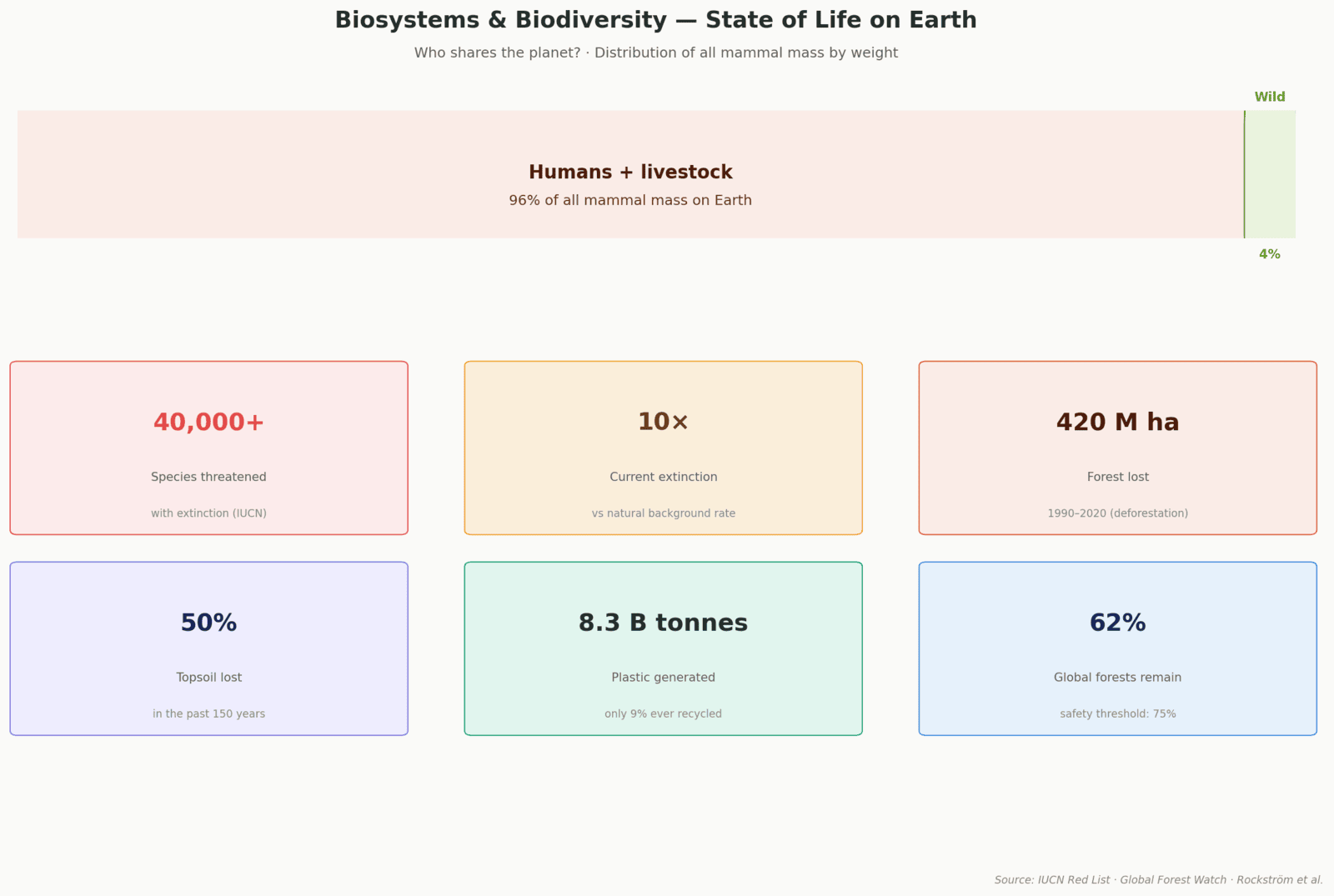
9. Biosphere Integrity - the extinction rate boundary is already ten times the rate compared with the Holocene era (pre-anthropocene/industrial revolution). The current human impact on the biosphere is the complete antithesis of seeing all life as sacred. Figure 3 outlines the seriousness of biosystem damage.
I’ll conclude with three points. The first is that Rockström’s Planetary Boundaries Framework is simple to understand, and it visually expresses the totality of what ought to concern every government in the world, and us.
The second point is that you don’t need to be a scientist or climate specialist to realise that, irrespective of nationality, race or religion, we are all in the same boat, or more accurately, the same spaceship, R. Buckminster Fuller (1895–1983), Operating System for Spaceship Earth4 1969.
My final point, and one I hope you will find helpful, is that if we consider all life sacred, not something to be used and abused, we will eventually be able to fix this.