
Introducing WaveX and Spiralis Energy for this final episode on tidal Stream and Wave Energy
In this final episode, we will examine two early-stage pioneers creating opportunities to unlock the potential of ocean energy: Spiralis Energy, a tidal stream innovator based in England, and WaveX, a wave energy company headquartered in Perth, Australia.
I’ll start with WaveX and provide some context before diving into the details. Then I’ll do the same for Spiralis Energy. We need more great pioneers like these.
I’ll start with WaveX and provide some context before diving into the details. Then I’ll do the same for Spiralis Energy. We need more great pioneers like these.
The context for WaveX
While I have so far written about European and UK pioneers in tidal and wave energy, an earlier episode in this series piqued the interest of WaveX founder and CEO Simon Renwick. He encouraged me to take a look at his company and what is happening in Australia, where he lives and works.Australia has the potential to become a wave energy powerhouse
I’ve since learned that while considerable pioneering is going on on my side of the planet, especially in the UK, France, and Sweden, Australia also has the potential to become a wave technology powerhouse. It has the largest wave energy potential in the world, based on its mean wave power density and direction (Gunn and Stock-Williams, 2012). The Blue Economy Cooperative Research Centre, sponsored by the Australian Government, estimated that the ocean wave power surrounding Australia was around 300GW, or ten times the average rate of consumption. The extensive coastline facing the expanse of the Southern Ocean generates concentrated wave energy with barely a pause.¹ The Australian potential dwarfs that of Europe, estimated at 70 GW, with roughly a third of this located around the UK and Ireland.²
The Commonwealth Scientific and Industrial Research Organisation (CSIRO) produced the CSIRO Australian Marine Energy Atlas, which indicates that the southern and southwestern coastlines, particularly near Tasmania, South Victoria, and Western Australia, are ideal areas for pursuing wave energy initiatives. Western Australia, particularly Albany and the Perth coast, offers excellent conditions and established ports, as well as offshore manufacturing facilities. Albany is currently a test site for several technologies, including the WaveX D-Spar ™.
WaveX — a startup with bold ambitions derived from 20+ years of Oil & Gas engineering experience
The majority of current wave energy solutions during the pilot phase are sited within a couple of miles of the shore, at depths of 4–10 fathoms, for easier maintenance, and move further out as the technology evolves.³ Yet deep-ocean waters theoretically generate the most energy. However, to date, practical deep-water solutions have not been developed. Most wave energy converter (WEC) developers have, quite reasonably, shied away from deep-ocean environments, as the risks and development costs have seemed insurmountable. A case of harvesting the low-hanging fruit before taking on the ambitious task of deep water wave energy capture in often considerably hostile sea conditions.Renwick takes a leaf out of the O&G industry’s playbook
Simon Renwick, with over twenty years of experience in deepwater engineering within the offshore oil and gas industry, offers a distinct perspective on this wave energy challenge.
A few years before founding WaveX in January 2023, he had an epiphany whilst on the deck of a large construction vessel in the middle of the ocean. His idea was to base a deep-water WEC on the proven design of a floating oil and gas structure that uses a Spar to balance buoyancy and ballast, with a deep draft submerged beneath the sea to safely harness the effects of wave heights, wind, and ocean swells. This would create a steady platform. If you visit the WaveX website, the first thing you will see is this statement: Renewable technology that breaks through existing barriers and opens up the other 50% of the planet — our deep oceans. Lateral thinking and imaginative use of proven technologies could be the answer, rather than the overly-complicated Heath Robinson-esque approaches of earlier developers.
Undaunted by past WEC developer failures
Renwick is racing to deliver the first commercially viable WEC, or as he prefers to call them, wave-powered generators. Others, such as the Australian company Oceanlinx, have attempted and failed. It lost its 1MW prototype oscillating water column off the Sydney coast, which was bashed by high seas despite several redesign attempts, and went bankrupt in 2014. Similarly, several companies have also failed to meet the engineering challenges.As recently as 2019, Carnegie Clean Energy, a former flagship of Australian marine renewable energy, entered administration. The collapse followed the Western Australian government’s withdrawal of A$16 million funding for the Albany Wave Energy Project. Despite high hopes of becoming Australia’s first wave farm, it failed to hit its first milestone, leaving the WA government and private investors significantly out of pocket.⁴ It has since been resurrected. It made a comeback since its collapse in 2019. The company was recapitalised and returned to trading after its shares were reinstated on the ASX. It shifted its strategy to focus more on licensing its wave energy technology, CETO, to other renewable energy firms.
These failures, despite the irrefutable potential of wave power, echo those of the UK, most notably the 2014 collapse of Pelamis Wave Power. The complexity of its WEC solution, which resembled a giant snake floating on the surface, required constant maintenance and failed to withstand harsh sea conditions. Commercial partner E.ON lost faith and withdrew its financial backing in 2013. E.ON instead shifted its focus to more mature renewables like wind and solar.⁵
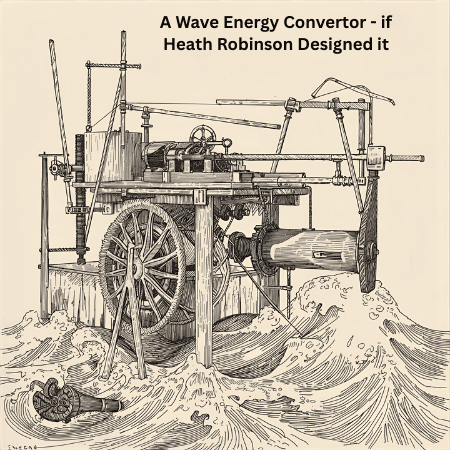
- The D-Spar ™ solution from WaveX inspired by the O&G industry’s D-Spar floating platform
- Renwick and his team of engineers, with between them 150 years of O&G experience involving over 1million tons of offshore structures, have designed a wave energy generator or WEC, as it is more commonly known, based on the following principles:
- No moving parts under water, to enhance survivability and minimise maintenance costs.
- Based on proven technology from the O&G industry, the Spar floating platform for deep water environments.
- Access to existing O&G fabrication supply chains around the world, so that it can be licensed or built by third-party partners, and not limited to Australian coastal waters. This will also accelerate speed-to-market.
- Scalability.
- Minimal impact on sea life — no underwater turbines that might harm sea life or damage the environment in any way.
Images for the D-Spar™ are currently under wraps, as WaveX wants to get a head start before others attempt to follow a similar path. However, I’ll outline its operating principles.
How the D-Spar™ works
The principle behind the D-Spar™ is based on a self-reacting two-body heaving mechanism that converts the vertical motion of the waves into electricity. It consists of an inner spar and an outer spar, the larger of the two that move vertically relative to each other as waves pass. An internal power take-off (PTO) system produces the energy. The design leverages existing (O&G) engineering practices, utilising proven moorings, fabrication methods, and subsea cables. Its self-contained floating design allows it to operate in deep waters without any complex infrastructure, reducing costs and complexity. It oscillates in tune with the waves to increase energy capture. The power generated can be used with any existing wind farm infrastructure, meaning that in periods of calm when wind turbines stop generating electricity, it picks up the slack, improving the overall value of the wind farm and maintaining power output while further reducing the levelised cost of energy (LCOE). The case for augmenting wind and solar with wave as power sources will minimise the risk of power outages due to weather conditions — see Figure 2.
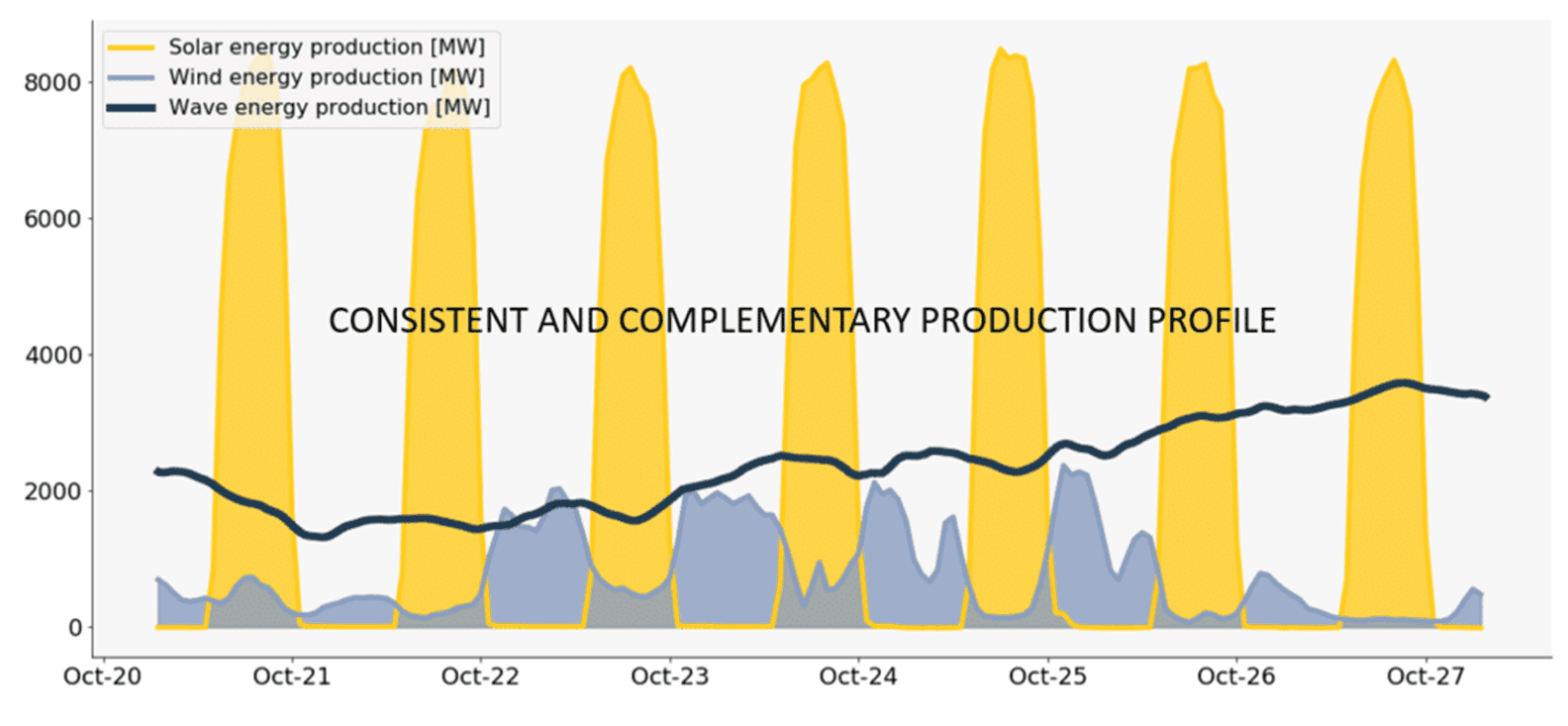
Once ready for commercial launch, wind farms will be its first target market. Other markets include Defence, providing energy for autonomous UAVs, and wherever remote power is required, such as in support of the emerging decarbonisation industry. The latter will be particularly relevant as once WaveX technology achieves full scale, it has the potential to abate more than 500 megatons of CO2 annually — one reason why WaveX has been shortlisted for a global energy accelerator.
Deep sea, unlike most WEC companies
Unlike any other current WEC, the D-Spar™ is designed to operate in deep water. The successful WEC company, CorPower Ocean, is designed for use in seas within 10 miles of the shoreline. Similarly, EcoWave Power, an Israeli company, is a pioneer in nearshore wave energy.
Other use-cases WaveX is targeting
In the near term, WaveX has set its sights on two additional use cases, both of which offer substantial growth opportunities and involve delivering an autonomous power point in the ocean.
Offshore Floating Data Centres — As AI demands ever more energy and massive data centres, several leading tech companies are investing in offshore data centres, which have the advantage of water cooling and lower energy costs from solar and wave energy. Market.US forecasts substantial growth from around US$316.7 Million in 2024 to US$828.9 Million in 2034.⁶
Offshore Floating CCUS (Carbon Capture, Usage and Storage) — By the mid-2030s, the CCUS market is forecast to be worth around US$30 30Bn, of which 10% to 20% may be from offshore floating CCUS.⁷
Both of these opportunities are well-suited to WaveX D-Spar ™ technology, either as a standalone power source or in combination with floating solar or wind.
WaveX development timeline, partnerships and future
Figure 3 provides an overview of WaveX’s timeline and a shortlist of current development partners.
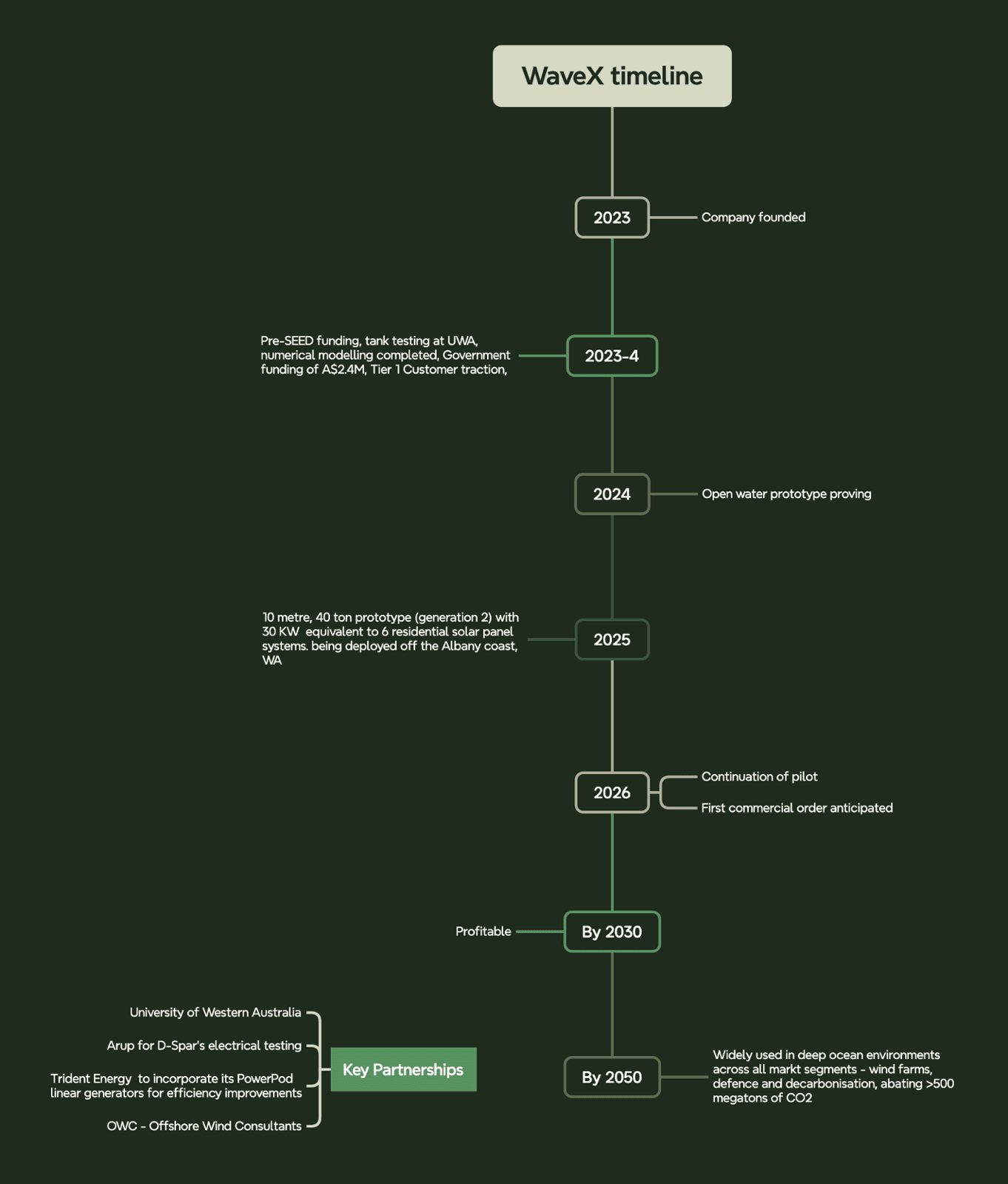
Over the last two years, since the company was founded, tank testing with the University of Western Australia and an open-water deployment of a 1:40-scale prototype have demonstrated that the D-Spar™ can generate electricity.
This year, 2025, the first full-scale prototype is being deployed off the coast of Albany, and it will undergo thorough testing and validation throughout 2026. Testing output will feed back into continuous development, ready for commercialisation. The company already has 25 non-disclosure agreements with Tier 1 global businesses. WaveX’s de-risking strategy, which leverages existing technologies and adapts them for deep-sea wave energy generation, is clearly paying off.
Business model and route-to-market
WaveX expects to sell or lease its technology, initially to wind farm owners, before exploring other opportunities for offshore energy requirements in defence, IT, and floating data centre owners, as well as floating CCUS.
Final observations
WaveX is unique among the companies I have covered in this series, as the only one focused on deep-sea deployments. Understandably, given the early market failures, the others could be described as near-shore, within ten miles of the coast. WaveX’s approach of leveraging proven technologies and engineering techniques, augmented by patented IP and a ready-made global supply chain, positions it to become a leader in this arena. The following two years will be vital in establishing its commercial viability, but the signs are auspicious.
Spiralis Energy — Tidal Stream Energy from the Seas and the Rivers
Spiralis Energy is another innovative new entrant in the tidal stream energy sector, bringing a novel approach to tidal energy capture and conversion. For those unfamiliar with tidal energy, it stands out from other renewable energy sources due to its predictability. The gravitational interaction between the Earth, Moon, and the Sun generates the tides. It is not weather-dependent and is increasingly viewed as a reliable addition to a portfolio of renewable sources, albeit at a currently higher cost. As the technology evolves, it will close the cost gap with more mature renewable energy technologies.
The UK Government has overlooked the potential for Tidal Stream Energy
Miliband’s wind myopia overlooks the potential of tidal stream and wave energy, and overstates the effectiveness of wind. An article in the Daily Telegraph by Matt Oliver on the 28th October, 2025,⁸ found that Ed Miliband, Secretary of State for Energy Security and Net Zero, a wind farm champion had exaggerated the wind’s ‘load factor’, the proportion of the year when turbines are expected to generate power, and revised his figures down from 61% to 43%. Despite its predictability, tidal energy, unlike wind or solar, has been largely overlooked.
The case for tidal
The UK Marine Energy Council, in its 2024 Tidal Stream Technology Roadmap report, published by the Offshore Renewable Energy (ORE) Catapult,⁹ identified several technology innovations that could lead to an 80% reduction in tidal stream energy prices, subject to commercial success. These, if implemented, would reduce power generation costs below those of nuclear. A tidal stream capacity of 1 GW would provide around 11% of the UK’s electricity between 2030 and 2035, once scaled sufficiently. Their prediction shows a levelised cost of energy (LCOE) of £50-£72/MWh would make tidal stream economically competitive with nuclear and other renewables.
UK and France collaborate despite Brexit
The EU, through its EU Regional Development Fund, sponsors the TIGER (Tidal Stream Industry Energiser¹⁰) project to drive the growth of tidal stream energy in both the UK and France, despite Brexit. It is a highly collaborative project led by the UK’s Offshore Renewable Energy Catapult, focused on tidal energy in the Channel between France and the UK. €45.4 million of EU funding and £20 million per year in Contracts for Difference subsidies are provided to support commercialisation. To date, 8MW of new tidal capacity has been delivered in various test sites. With another 57.4MW planned as tidal stream energy solutions become commercially viable, this will provide a platform for the UK to realise the potential of 1 GW, or 11% of the UK’s energy, by the middle of the next decade. The UK Marine Energy Council is lobbying GB Energy to invest 3% of its £8.3bn budget in tidal stream and wave energy. Spiralis CEO Guy Lavene is a board member of the UK Marine Energy Council. In short, the opportunity for Spiralis Energy is substantial and realistic, despite Miliband’s myopia.
Background to Spiralis Energy and its biomimetic innovation approach
Nicholas J. Davis founded Spiralis Energy on August 14, 2023. He has been involved in numerous startups, some of which have been successful, while others have not. However, he has a passion for sustainable ocean technology. The current CEO, Guy Levene OBE, has extensive experience in logistics and project management, gained as a British Military Advisor and Second-in-Command of 105 Logistic Squadron. While Davis initiated the design of its tidal turbine, the axial skelter, Spiralis Energy has augmented its small marine engineering leadership team by partnering with Cape Horn Engineering for computational fluid dynamics.
Inspired by nature
The humble Turritella seashell inspired Spiralis Energy’s first tidal stream generator, which comes in two forms: one for offshore tidal environments, allowing for bidirectional energy capture as tides come in and go out, and the other, resembling the seashell, for rivers (see Figure 4).
The advantages of the Turritella shape include superior flow dynamics, resulting in highly efficient tidal energy conversion and exceptional durability.¹⁰
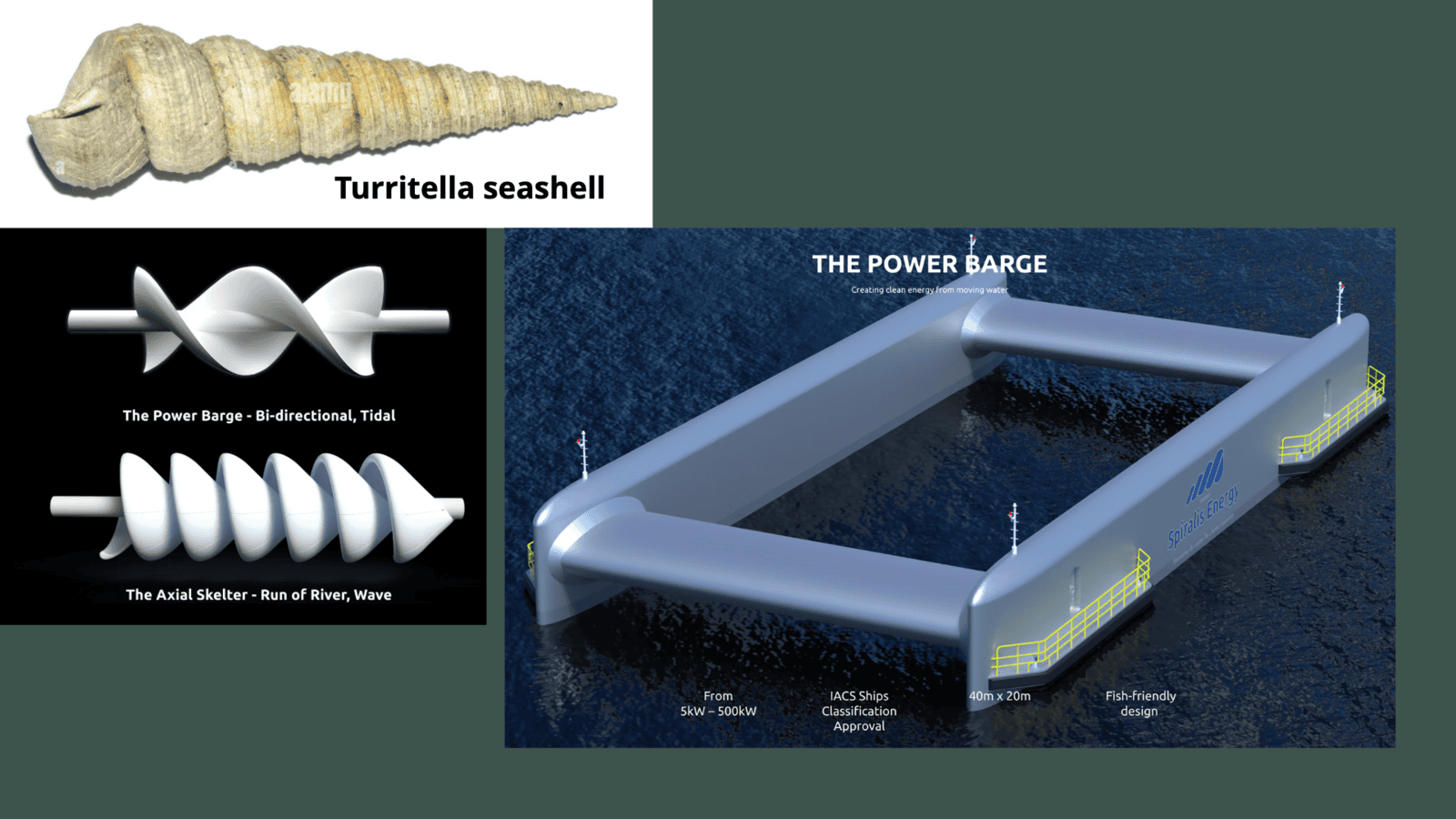
The Axial Skelter has several significant advantages:
Simplicity and reliability: it has only one moving part underwater, minimising mechanical complexity, which has bedevilled earlier generations of tidal energy converters.
Rapid and sustainable manufacturing, using 3D printing of 100% recycled plastic combined with a steel frame. It can be manufactured to order anywhere in the world and delivered in modular units within weeks.
It can be scaled easily to support island communities or larger-scale offshore environments connected under a certified floating power barge, anchored in tidal currents.
The turbine consists of a single Archimedes or Turritella screw-shaped rotor with aerofoil cross-sections generating greater lift and torque from tidal currents than earlier designs by other companies.
The Power Barge is the floating platform for future large-scale tidal stream arrays.
How it works
The helical screw shape rotates in tidal flows and drives a direct coupling to a permanent magnet generator sited above the water, making it easier to maintain. There are no sharp edges to harm fish or other marine animals, as the aquarium video on the home page illustrates.
Power output depends on the configuration and scale of the installation, but ranges from 5kW to 500kW.
Current state of development
In November 2024, Spiralis Energy secured an investment of £800,000 to fund the build and testing of the Axial Skelter tidal energy unit from energy investor Kistos Holdings.¹² According to Spiralis, each unit can deliver enough energy to brew 250,000 cups of tea per day. Additional crowdfunding has also flowed in through the company’s Tides2Tea campaign. The campaign encourages interest among coastal communities and highlights the connection between tidal energy and the everyday experience of brewing tea.
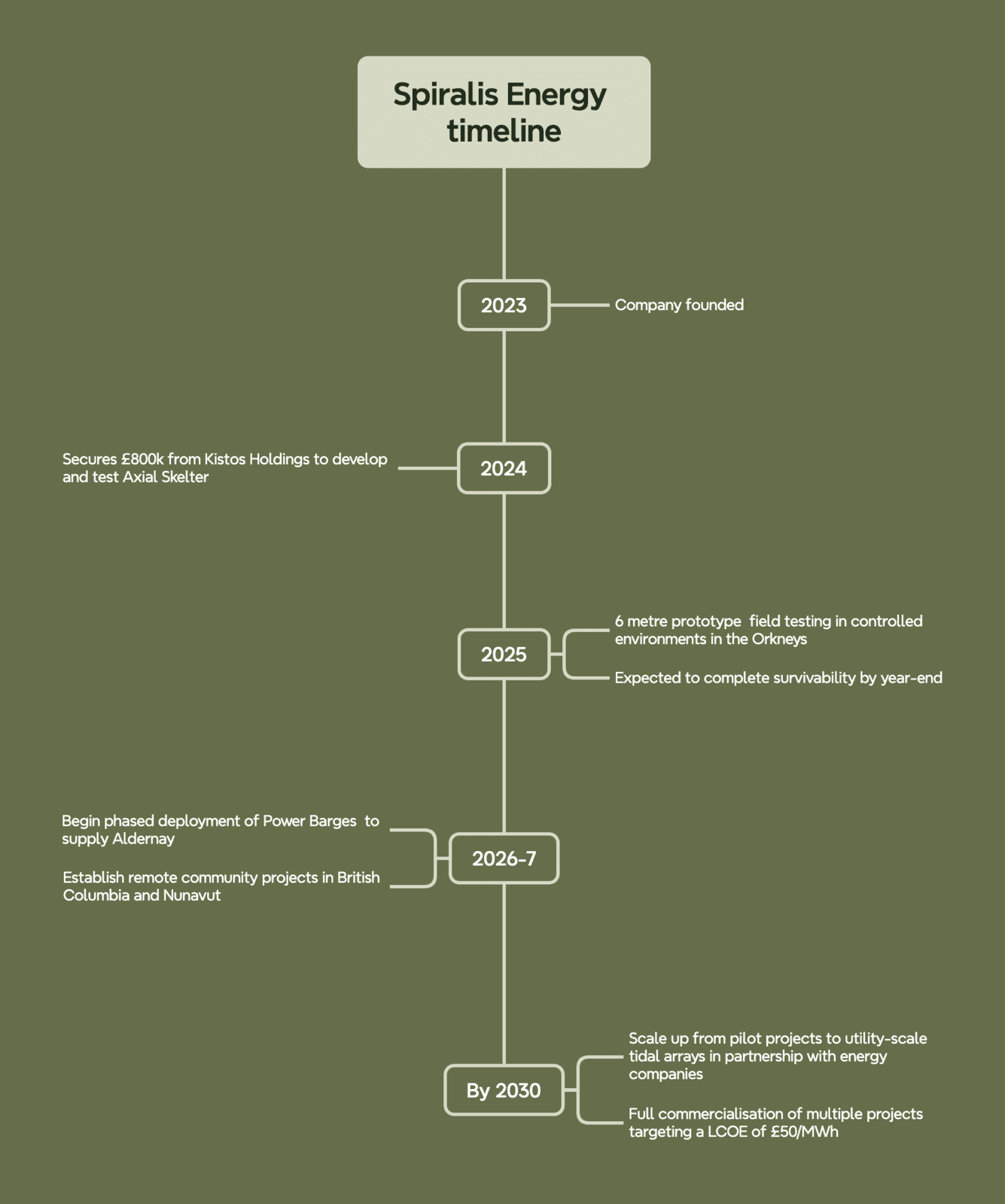
Figure 5 presents a timeline of key events and plans from 2023 to 2030.
Spiralis had hoped to site its first Axial Skelter off the Aldernay coast, to provide community energy; however, this has been delayed until onshore infrastructure is in place. The company hopes to return once the initial pilot in the Orkneys proves successful.
Survivability trials have begun in the Orkneys and are expected to be completed by the end of 2025. Once proven, the company aims to deploy Power Barges in phases from 2026 to 2027. Meanwhile, Spiralis hopes to establish a foothold in Canada, renowned for its tidal potential.
The elegant and resilient biomimetic design of the Axial Skelter and the Power Barge offers considerable promise, complemented by the 3D printing capability, which creates opportunities for rapid scale-up and potential licensing worldwide. I look forward to watching the company’s progress.
Final comments on WaveX and Spiralis Energy
What struck me about both companies and why their futures look so promising, is their pragmatism which should lead to accelerated development speeds. WaveX builds on proven technology, while Spiralis Energy take a leaf out of Nature’s book, to develop something designed for the sea. Different inspirations but both loaded with promise.
Footnotes: